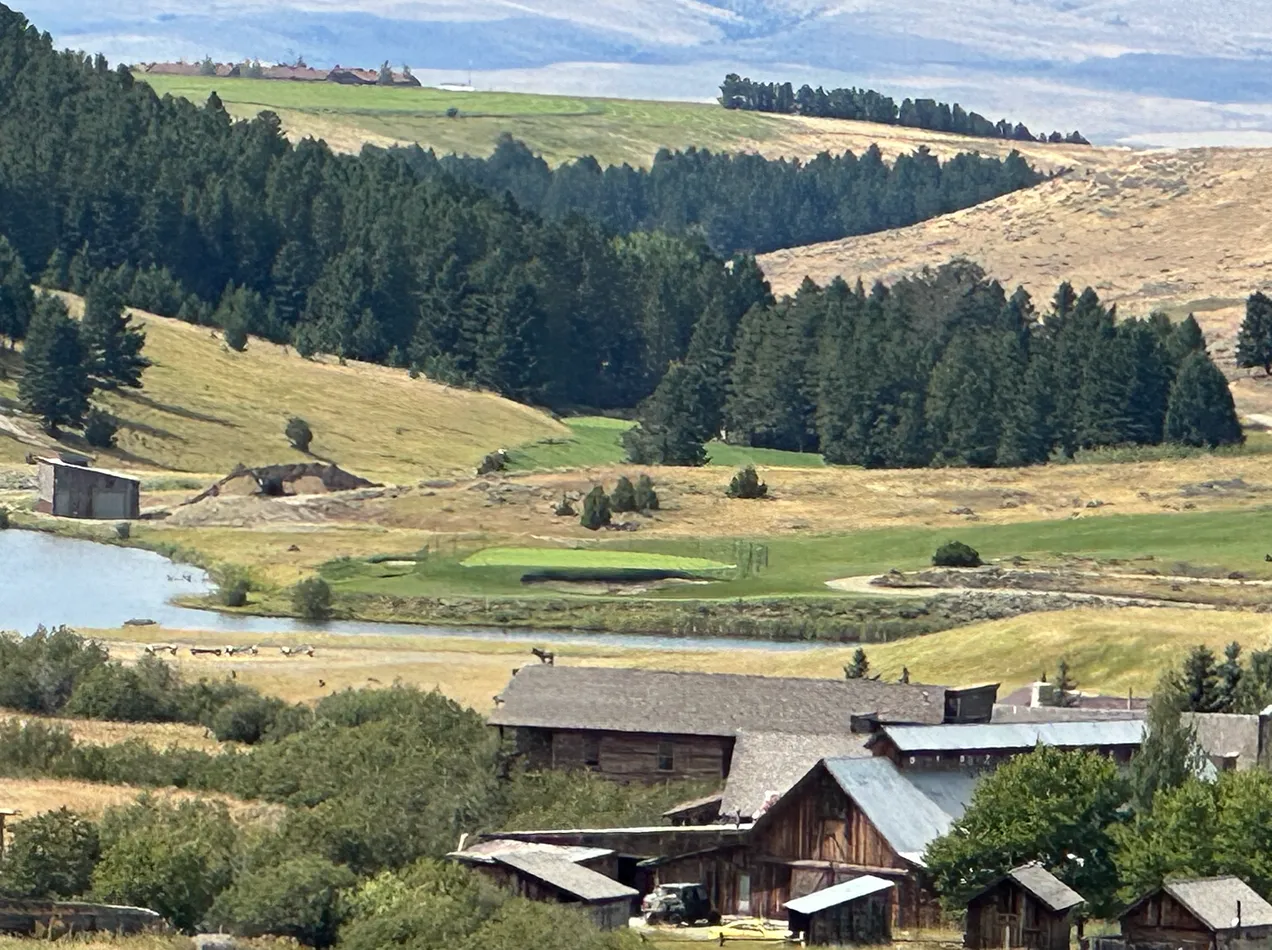
The Yellowstone Club markets itself as “one of the most exclusive destination residential developments in the world. The club and community occupy approximately 13,400 acres, representing the world’s only private ski and golf community.”
In 2024, Yellowstone Club hosted a fundraiser for the republican presidential candidate; tickets were between $100,000 and $844,600.
The YC expanded into the Crazy Mountains in 2021 by purchasing the 18,000 acre Marlboro Ranch. The Yellowstone Club in the Crazies spans Park and Sweet Grass counties. It’s properties are held under the name CMR Ranch Owner LLC. It was the setting for various scenes in the series “1883.”
The Yellowstone Club advertises its location in the Crazies “as incredible a setting as there will ever be for the game of golf.” Two “master routers” show their first look at the proposed course.
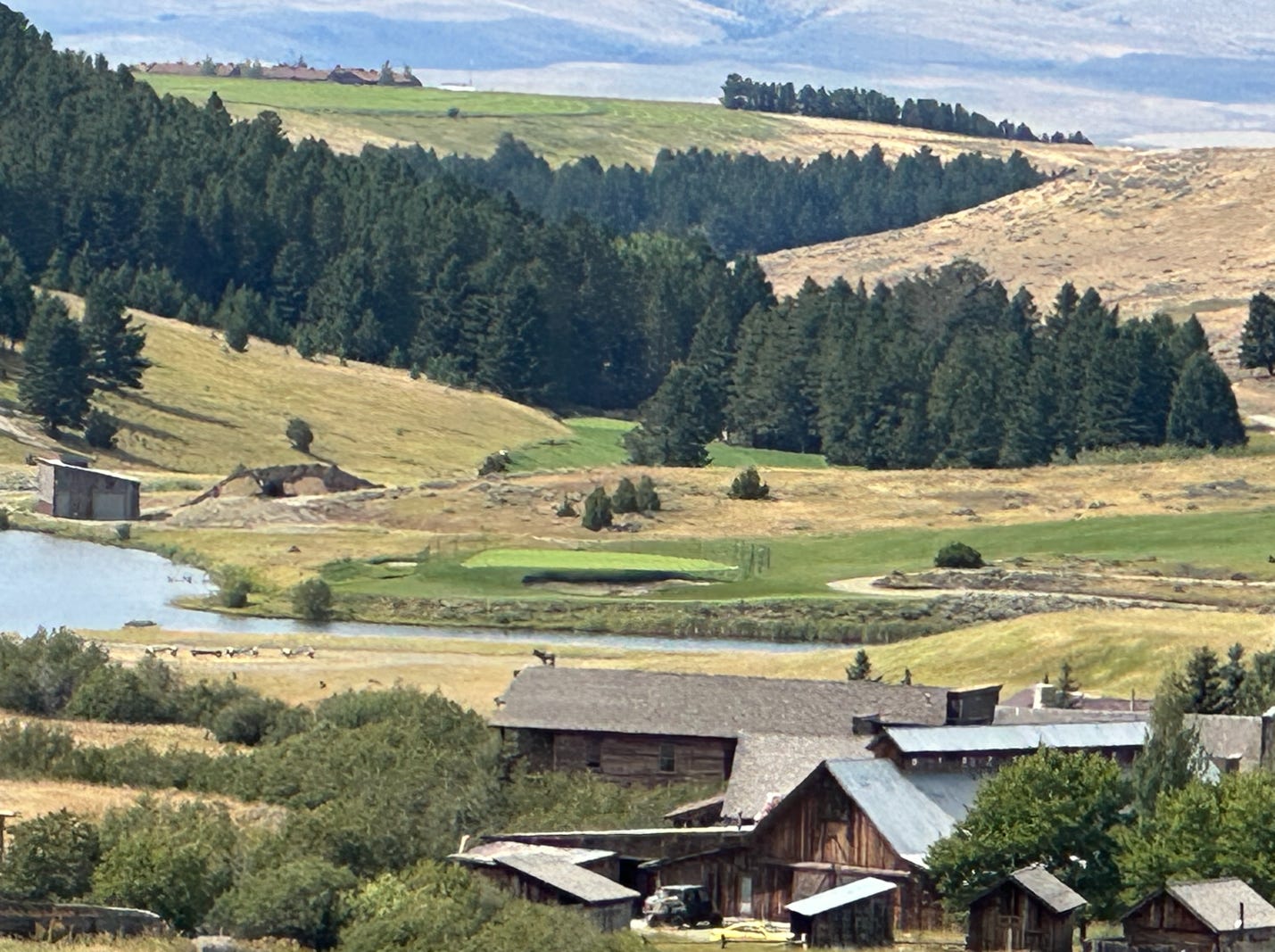
The thing about golf courses, it takes water to have those fancy greens.
Depending on climate and rainfall, a golf course can take between 1 – 6 acre feet of water per year. An acre foot of water is the amount of water it takes to cover roughly the area of a football field to a depth of one foot. The USGA advises that the first step in calculating a water budget for a golf course is to determine the total irrigated area. The American Society of Golf Course Architects recommends up to 200 acres for a par-72 golf course. Golf courses built in desert like climates can take up to 150 million gallons or more of water per year.

The thing about Montana, it’s pretty dry. Anyone who’s hit Pine Ridge Golf Course in Roundup appreciates the challenges of keeping up a good green in Montana.
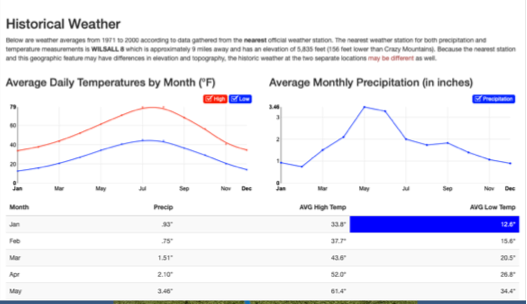
The average monthly precipitation in the Crazies is typical of Montana’s dry climate:
According to CMR’s own estimate, the Yellowstone Club’s Crazy golf course requires 2,700 gallons per minute to irrigate. The water rights claimed by CMR Ranch Owner LLC list stock and domestic use rights. It does not have water rights to irrigate a golf course.
What’s a Yellowstone Club member who wants to play golf in an incredible setting to do?
Montana’s prior appropriation doctrine of water rights comes from California. The California gold rush led to a custom where the first person to divert a stream to use a rocker or pan had the first right to that amount of water. That “first in time first in right” was later extended to farmers and other users, including on private lands, across the west.
Montana’s waters are the property of the state for use by the people. Water right holders do not own the water itself, but rather possess a right to use a specific quantity of water for a beneficial purpose.
Montana law defines beneficial use as “a use of water for the benefit of the appropriator, other persons, or the public, including but not limited to agricultural, stock water, domestic, fish and wildlife, industrial, irrigation, mining, municipal, power, and recreational uses.” Through Montana’s history, court and agency water law decisions have held that beneficial use is the basis, the measure and the limit of all rights to the use of water and that “[A]pplication to a beneficial use is the touchstone of the appropriation doctrine.”
In 1972 Montana adopted its constitution. Article IX, Section 3 recognizes existing water rights, and provides:
(2) The use of all water that is now or may hereafter be appropriated for sale, rent, distribution, or other beneficial use, the right of way over the lands of others for all ditches, drains, flumes, canals, and aqueducts necessarily used in connection therewith, and the sites for reservoirs necessary for collecting and storing water shall be held to be a public use.
(3) All surface, underground, flood, and atmospheric waters within the boundaries of the state are the property of the state for the use of its people and are subject to appropriation for beneficial uses as provided by law.
(4) The legislature shall provide for the administration, control, and regulation of water rights and shall establish a system of centralized records, in addition to the present system of local records.
The Montana Water Use Act was implemented for the primary purpose of regulating water rights in Montana in satisfaction of Article IX, Section 3.
The legislature declared a system of centralized records recognizing and establishing all water rights as essential for the documentation, protection, preservation, and future beneficial use and development of Montana’s water.
In golf, a “gimme” is a shot that players consider “unmissable”. Water law in Montana has no gimme – no matter how rich you are, or how close the water is, you can’t just pick it up and take it.
Under Montana law, Yellowstone Club cannot “appropriate water or commence construction of diversion, impoundment, withdrawal, or related distribution works except by applying for and receiving a permit” and changes to its water rights require approval from the Montana Department of Natural Resources and Conservation (DNRC) to ensure other water users are not adversely affected.
In December of 2023, CMR filed an application to “change” their water rights. In the spring of 2024 local landowners whose water rights would be impacted objected to the proposed changes. CMR developers hosted community meetings to address landowner questions.
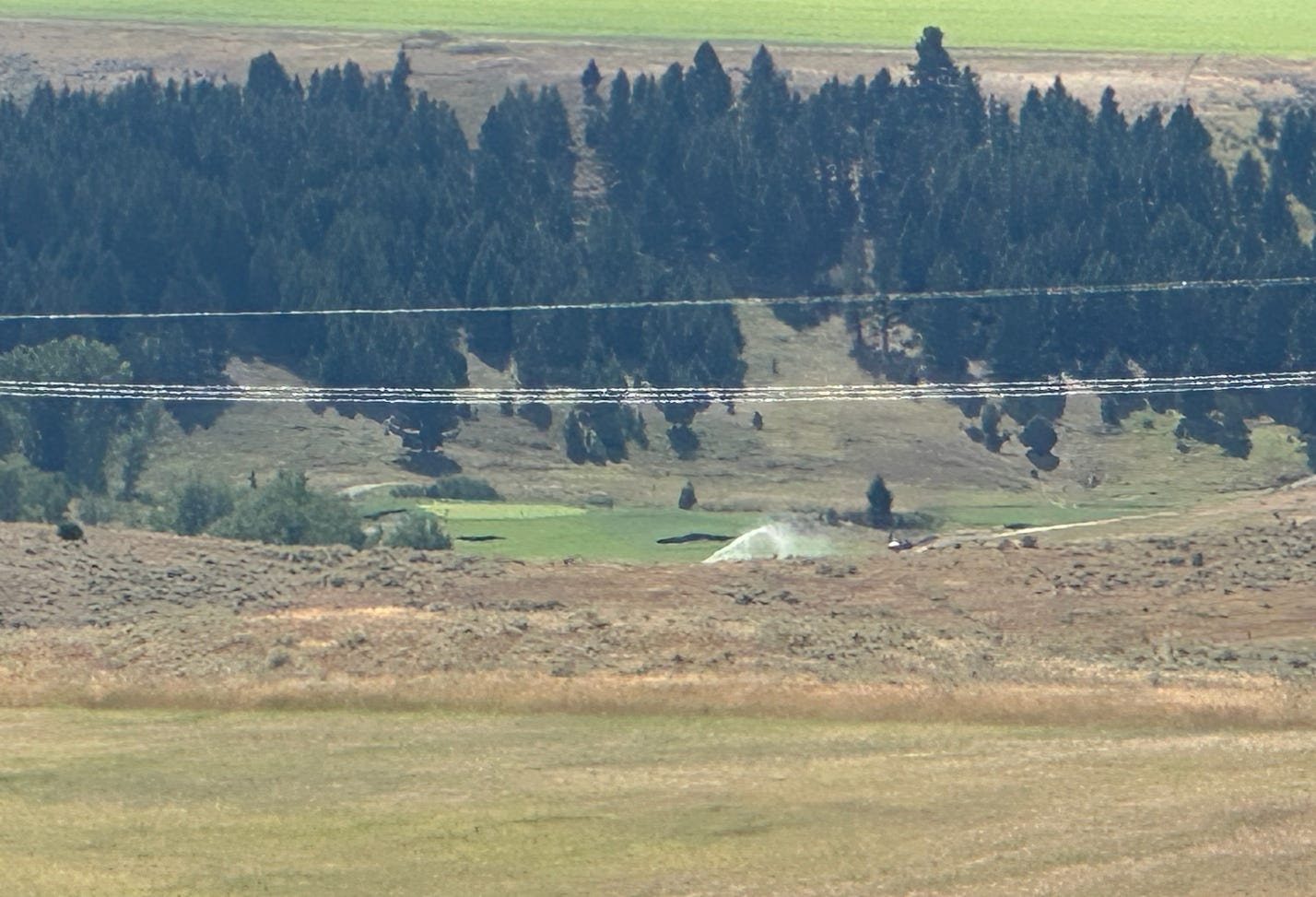
In August of 2024, local landowners were made aware that CMR was proceeding to develop its golf course, diverting water and irrigating, without legal rights to do so. CMR showcased a five-hole loop at the “private destination.”
Photo and video evidence from the fall of 2024 shows water being diverted and golf course irrigation taking place, which is illegal. It also violates the water rights of local ranchers and landowners.
In November of 2024, CMR withdrew their change applications.
On May 16, 2025, representatives from Crazy Mountain Ranch and Lone Mountain Land Company told local landowners they were continuing to irrigate their new golf course —despite the fact that they do not have a legal water right for that use.
At the meeting, CMR representatives confirmed they started watering the turf last year and are already operating illegally this year:
- [CMR is] planning to irrigate until someone forces them not to.
- [CMR is] going to put water on the golf course …they have to keep that investment [turf] alive.
- I don’t expect any sympathy, but they have millions of dollars invested [in turf] and they don’t plan to just sit back and let it die.
- In 2025, we’re not going to have approval for the golf course. And the intent is to irrigate the golf course.
Local landowners asked questions and got the following answers:
Q: “Did you irrigate the golf course last year?”
“Yes.”
Q: “You didn’t have the water rights or the permission to do it?”
“Correct.”
Q: “But you did it anyway?”
“Yes.”
Q: “If this goes through will it be complete in time to use for the 2025 season?”
“No.”
Q: “So what are you going to do in ’25?”
“They are planning to irrigate the golf course this year and we are hoping to operate as if the changes are approved.”
Q: “You are going to do it illegally then?”
“The plan is to irrigate the golf course.”
Q: “Have you started to irrigate the course this season?”
“Yes. The greens.”
Q: “That means you are operating illegally.”
“The sod showed up so we are stuck in this position. Do we let it die and waste the investment, or do we make a deal and keep going?”
Irrigating the golf course without legal water rights …. is illegal. It also means downstream water users will have immediate reduced access to early-season water and a summer of uncertainty.
The thing about the law, you can’t just “make a deal” that it doesn’t apply.
Montana law sets out a process for water users to follow. America is a nation of laws – not of kings, not of rich dealmakers to whom the law does not apply. We are all accountable to the rule of law and fair process. And to each other.
All together.